Five Reasons You Should Make Your Own Notebooks
“Because the notebook you make is unique, the act of pulling it out, paging through it, etc. hardwires the knowledge your are scribing deeper into your memories and engages your brain more actively…”
And “cheaper than buying” is the very last one!
This may be a rather weird article to write after my recent endorsement of splurging on new notebooks, but it’s also a bit self-serving, as Papermancy Workshopsare literally about doing just that…but this is not me trying to drum up participants.
This is more me justifying to myself why I feel this practice of making magic* happen with paper and pens is valuable — especially to my ADHD brain, but honestly for everyone.
1. You’re making a playground for tactile cognition
A notebook is the ultimate multi-format personal knowledge management tool.
- You can create and save in almost any text, image, design, calendar, flowchart, gameboard, graphic social commentary, vision board, even 3-d if you want to get fancy with pop-ups).
- The interface (stylus + surface) is one that you’ve been using since you were an infant.
- No ads.
- No algorithm (unless you make one).
- No guidance except what you choose to experiment with. Bujo? GTD? Sketchnotes? Zentangles? Morning Pages? Collage?.You can take your pick, and change at the turn of a page — or combine them all in one gesamtkunstwerk of your brain.
- Cross platform compatible with tech, thanks to the ubiquity of cel phone cameras and the advance of optical text recognition. If you take pictures of your notes and store them in Apple Notes or Google Drive, you can search for a phrase and they will find it in your handwriting**
- Because the notebook you make is unique, the act of pulling it out, paging through it, etc. hardwires the knowledge your are scribing deeper into your memories and engages your brain more actively (more on this in another article coming soon).
2. You get exactly the notebook you want, in a form that works for you.
“Bespoke” is a magical word. I first came across it in the movie “the Tailor of Panama” ( #recommend) but didn’t think much of it. When I wore suits, which was rarely, they were off-the-rack, often from a thrift store.
Then I spent a year exploring the “Art of Manliness” (both the podcast and also just the general subject), and I discovered that while I couldn’t afford a bespoke suit (one made from scratch to my measurements), I could afford a nicer-than-usual one and then have it tailored***.
Everyone should have the experience of wearing tailored clothes, at some point in their life.
There is such a difference to wearing clothing that is made to fit you, rather than trying to fit into clothing that was just made. It changes the way you feel in the world, the way you move. I found it more restful, because I wasn’t constantly adjusting either the clothing or my body to try and make it look the way I thought it should.
Great, Gray, what does this have to do with notebooks?
Your notebooks should fit you, as well. Sometimes that’s as simple as buying the right one; lately, for me, the “right” everyday notebook is a Caslon XL Multimedia sketchbook:
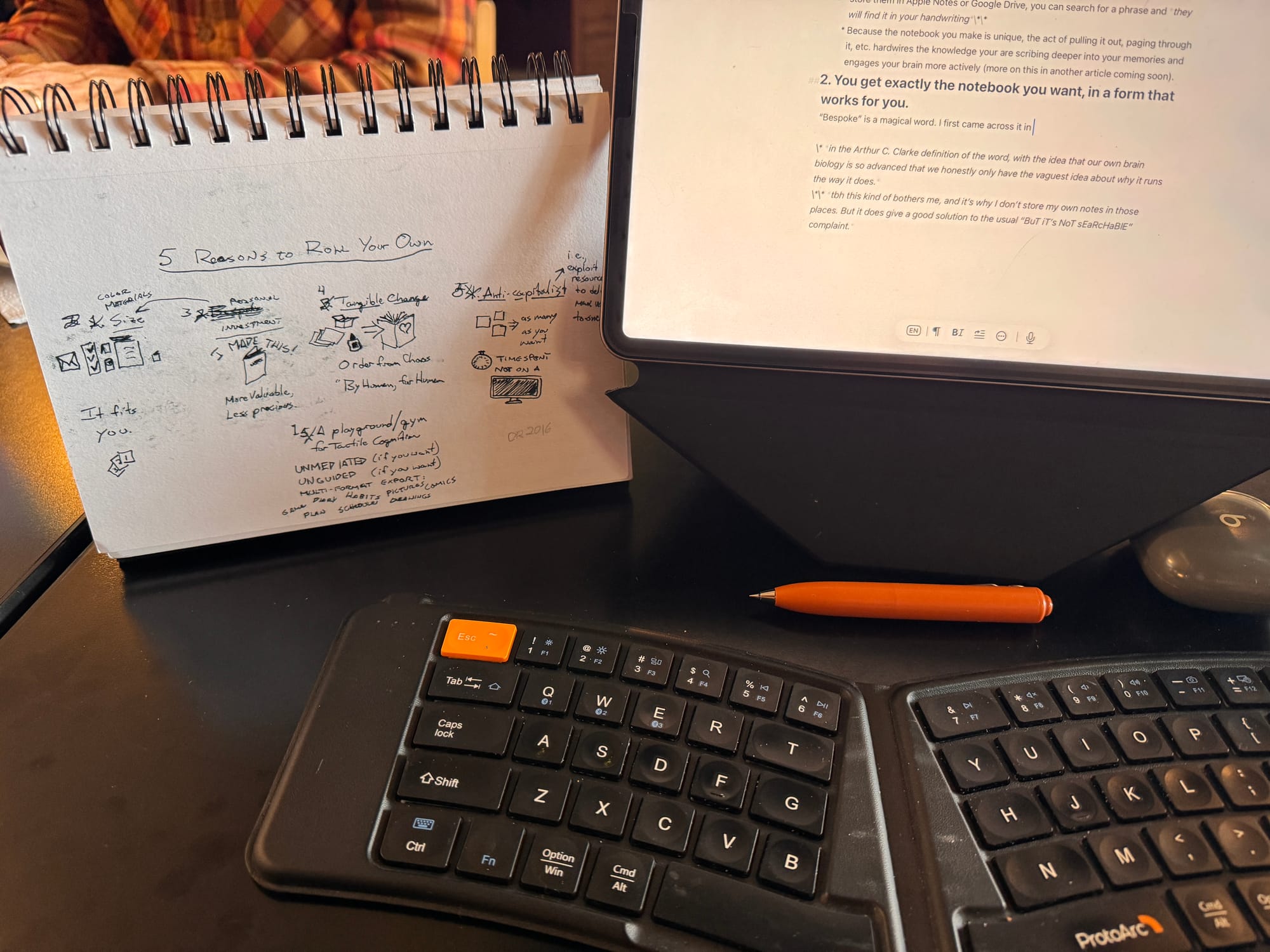
Allow me to list the many ways this notebook works for me:
- Spiral binding, which lets it lie flat for real (many notebooks claim to “lay flat” but really don’t).
- Blank, thick paper that doesn’t bleed with any of my many inks and allows me to sketch/outline/journal at will
- Also blank paper means can use it in landscape, which means that the problem of having a spiral binding get in the way (a curse of left-handedness) is taken care of.
- Pages are perforated and can be torn out at a whim
- The XL edition is hardcover, with a backing that allows me to scribe without needing a flat surface.
This isn’t a humblebrag about my cool notebook; this wasn’t even my idea (thanks again, Nina Cherie Flory Stephenson !).
3. “Labor leads to love.”
I’m holding an envelope to my forehead. Inside is the answer to this question:
What’s your most valuable resource, the one thing you wish you had more of?
Open the envelope: Time. (Ok, maybe not everyone said this, but I’m betting most of you, and even more have it in the top three things they wish they had more of, jockeying for space between “Keanu Reeves” and “chocolate”).
One of the biggest reasons people give for not using notebooks, especially not using them thoughtfully and deliberately, is not enough time.
I could make an argument that for most of us there is enough time, it’s just easier, more “fun”, to do other things, like doomscrolling YouTube or washing the dog or re-formatting our to-do list yet again.
I’m not saying that making your own notebook will give you more time. I just believe that you will be more likely to want to use something into which you’ve already invested your most precious resource. Kind of leveraging the sunk-cost fallacy, but in our favor.
It’s known as the IKEA effect, and while most research tends to focus on how you can make consumers pay more for things they have to assemble, there’s some hints in papers such as this one that indicate that if you make it, you will feel:
“…a fundamental human need for effectance – an ability to successfully produce desired outcomes in one’s environment – and one means by which people accomplish this goal is by affecting and controlling objects and possessions…” — The “IKEA Effect”: When Labor Leads to Love
There’s all kinds of psychological phenomena associated with that — locus of control, for example — but what it comes down to is that you would be more likely to spend that precious resource — time — on something that you valued more because you made it yourself.
Not only that, but…
4. You’ve made a tangible change in the world.
I want you to imagine something, unless you’re lucky enough to remember it.
Imagine yourself as a child. Before you could walk, even, just about when you were sitting up, when everything around you needed to be tasted, everything was new, and the only way you could really communicate was through a nonverbal spectrum from cooing through giggling up to screaming.
At some point, when most humans are that age, some adult will put something strange in your hand. Of course, anything in the hand immediately goes into your mouth, but this doesn’t taste good — it’s waxy, or maybe chalky, or maybe just kind of bitter, but it doesn’t seem very yummy, so you are about to put it down, when you’re distracted by the other thing the adult does: they put a flat blank surface in front of you. You don’t have words for black or white or even square or rectangle, but when the adult takes your hand — still holding the Thing — and runs it across that blank surface, something magical happens.
It leaves a mark.
There is something left after your hand holding the crayon/chalk/brush/paint meets this surface.
This is possibly the first experience many of us have of changing our environment (that isn’t related to digestion). And while I’m not a sociologist specializing in infant cognition, if I was I’d be fascinated to learn why so many caregivers in so many cultures make this one of the first things they do with children.
In the meantime, by taking some paper, thread, glue, staples, and other disparate items and turning them into a laboratory for your thoughts, imagination, and life — you’re reconnecting with one of the first skills you ever learned. You’re making order out of chaos — or, perhaps, you’re creating a container to get the chaos out of your brain and into a different container.
5. It is anti-Capitalist.
Before I get put on some government list (#toolate) let me explain what I’m talking about when I say “anti-Capitalist”: I mean that the more you make your journals yourself, the less resources and people were extracted/exploited to bring maximum gain to a few people.
I’ve got nothing against commerce. If I make a thing, and you want that thing, and can give me a mutually agreed upon symbol of value (like, $10, or a Liga Privada cigar), then we’re both happy!
If, on the other hand, you want me to work ten hours a day making notebooks that you buy from me for a buck and then sell on Amazon for $20…well, we’re going to have a problem.
There’s also the principle, so eloquently coined by Cory Doctorow, of “enshittification” — which includes extracting the most value from a products reputation while spending less on what built that reputation in the first place. Within the world of notebooks, the poster child for this is Moleskine brand — which claims to be the notebook of Hemingway and Picasso, but is really an entirely different company that has made noticeably shoddier product over the years.
So if, like me, that bothers you, one way you can avoid it is by making your own shoddy products…wait, let me check my notes, that doesn’t sound quite right…
What I mean is that when you are building your own notebook, you’re opting out of a little bit of the advertising, the online payment processors, the surveillance, the carbon footprint, the exploited delivery drivers, etc.
I’m not pretending that will make any difference to Mr. B. But I do believe, based on my own experience, that it will make a difference to you.
How to make a notebook.
- Take a piece of paper. Any size you want, but A4 or letter is usually convenient.
- Looking at it in portrait orientation (so it’s taller than it is wide), fold it up from the bottom to the top.
- Turn it 90°.
- Fold it in half again.
- Repeat steps 3 & 4.
- Unfold it twice — you will be back to a folded piece of paper, half-size, divided into four sections by two creases. (If you make the creases really sharp, it’ll be a big plus).
- Use some tool like scissors or a craft knife to cut the center crease from the fold up to where it meets the crease going edge-to-edge. ****
- Now unfold the paper completely, and fold it in half along the longest crease.
- Pick up the paper by grabbing each corner at the fold, so it’s perpendicular to the paper,and push them together, until the cut you just made gives you four different sections, each 90° from the next one.
- Fold them over each other along the creases until it’s a 1/8th-sized rectangle.
Congrats! You’ve made an 8-page “zine” style notebook!
Wondering what you’re going to do with it? It’s entirely up to you, but I have a pretty simple suggestion for you:
- For one week, carry it wherever you normally carry your phone, along with a little pen or pencil or even crayon. Carry your phone somewhere else, just for this week.
- When the urge to “check” the black mirror comes, you’ll grab the notebook and pen (or whatever) instead.
- Channel your inner toddler and make a mark. A word. A smiley face. A song lyric. Write what you see directly to your left.
- Take one more breath, and see if you want to mark the paper more. Maybe you do, maybe you don’t. Whichever it is, go with that urge.
- At the end of the week, take five minutes and look at the marks/words/pictures/to-dos you put on your notebook that you made. See how you feel about it.
If you like these kinds of little paper-based rituals and processes, you might really enjoy the upcoming Papermancy workshop. But regardless, I’d love to hear your thoughts and experiences involving it! Comment or email me at gray@papermancy.art .
* in the Arthur C. Clarke definition of the word, with the idea that our own brain biology is so advanced that we honestly only have the vaguest idea about why it runs the way it does.
** tbh this kind of bothers me, and it’s why I don’t store my own notes in those places. But it does give a good solution to the usual “BuT iT’s NoT sEaRcHaBlE” complaint.
*** Of course, my middle name is Taylor, so really, isn’t every suit I put on Taylored to some extent? #dadjoke
**** or get fancy and “deckle edge” it by just carefully tearing)